|
|
Jewelry, jewelry
store, fine jewelry,
wholesale jewelry,
jewelry retailer,
jewelry box
|
|
|
|
|
Welcome To Your Jewelry Information Website
on precious and semi precious
stones jewelry. From the mines where the gems are hammered
or washed out from the earth to the final product, a
beautiful piece of jewelry.
When you see our pictures you will understand why they say
'Diamonds are the Girls best friends' . Our jewelry website has a
strong visual orientation, to bring out the nature of the
precious and semi precious stones jewelry.
Have a look you can be almost
sure you haven't seen this jewelry before.
Most of the gemstones of the jewelries are covered and explained and you will
find a lot of links to find out more. Pls. don't be shy to
check the offers usually its worth to have a look
or a buy.
Guide to Buying Gold
Jewellery
Buying
jewelry can be fun, exciting and confusing. Whether you're
considering a gift of jewelry for someone special or as a treat for
yourself, take some time to learn the terms used in the industry.
Here's some information to help you get the best quality jewelry for
your money, whether you're shopping in a traditional brick and
mortar store by catalog or online.
Gold The
word gold, used by itself, means all gold or 24 karat (24K)
gold. Because 24K gold is soft, it's usually mixed with other metals
to increase its hardness and durability. If a piece of jewelry is
not 24 karat
|
|
gold,
the karat quality should accompany
any claim that the item is gold. The
karat quality marking tells you what
proportion of gold is mixed with the
other metals. Fourteen karat
(14K) jewelry contains 14 parts of
gold, mixed in throughout with 10
parts of base metal. The higher the
karat rating, the higher the
proportion of gold in the piece of
jewelry.
Most
jewelry is marked with its karat
quality, although marking is not
required by law. Solid gold refers
to an item made of any karat gold,
if the inside of the item is not
hollow. The proportion of gold in
the piece of jewelry still is
determined by the karat mark.
|
 |
Finest gemstones including
pigeon -
ruby - rubies
- and royal
blue sapphire
If you want to know more on various precious
stones have a look here,
Chantaburi in
Thailand is the main trading point on precious stones in Asia, most
people just dont know it. |
|
Deep blue sapphire cut and
facetted
Colors available: white, pink, blue, pastel - mixed
sizes: 2 mm up, calibrated |
 |
|
| |
| |
| |
|
 |
|
| |
|
|
| |
|
|
| |
|
|
| |
|
|
| |
|
|
| |
|
|
|
|
|
|
|
 |
|
 |
 |
| |
|
|
|
|
|
|
|
|
|
|
|
Multicolored spinels cut and
facetted
colors available: pink to red
size: one carat up
1.1 mm to 4.9 mm - calibrated |
 |
 |
|
|
|
Picture by jordanrich1 |
|
|
|
|
|
|
|
|
|
Jewelry can be plated with gold in a
variety of ways. Gold plate
refers to items that are either
mechanically plated, electroplated,
or plated by any other means with
gold to a base metal. Eventually,
gold plating wears away, but how
soon will depend on how often the
item is worn and how thick the
plating is.
Gold-filled, gold overlay and rolled
gold plate are terms used to
describe jewelry that has a
layer of at least 10 karat gold
mechanically bonded to a base metal.
If the jewelry is marked with one of
these terms, the term or
abbreviation should follow the karat
quality of the gold used (for
example, 14K Gold Overlay or 12K RGP).
If the layer of karat gold is less
than 1/20th of the total weight of
the item, any marking must state the
actual percentage of karat gold,
such as 1/40 14K Gold Overlay.
Gold
electroplate describes jewelry that
has a layer (at least .175 microns
thick) of a minimum of 10 karat
gold deposited on a base metal by an
electrolytic process. The terms gold
flashed or gold washed describe
products that have an extremely thin
electroplating of gold (less than
.175 microns thick). This will wear
away more quickly than gold plate,
gold-filled or gold electroplate.
Gemstones Natural gemstones are
found in nature.
Laboratory-created stones, as the
name implies, are made in a
laboratory. These stones, which also
are referred to as laboratory-grown,
[name of manufacturer]-created, or
synthetic, have essentially the same
chemical, physical and visual
properties as natural gemstones.
Laboratory- created stones do not
have the rarity of naturally colored
stones and they are less expensive
than naturally mined stones. By
contrast, imitation stones look like
natural stones in appearance only,
and may be glass, plastic, or less
costly stones. Laboratory-created
and imitation stones should be
clearly identified as such.
Gemstones may be measured by weight,
size, or both. The basic unit
for weighing gemstones is the carat,
which is equal to one-fifth (1/5th)
of a gram. Carats are divided into
100 units, called points. For
example, a half-carat gemstone would
weigh .50 carats or 50 points. When
gemstones are measured by
dimensions, the size is expressed in
millimeters (for example, 7x5
millimeters).
Gemstone treatments or enhancements
refer to the way some gems are
treated to improve their appearance
or durability, or even change their
color. Many gemstones are treated in
some way. The effects of some
treatments may lessen or change over
time and some treated stones may
require special care. Some
enhancements also affect the value
of a stone, when measured against a
comparable untreated stone.
Jewelers should tell you whether the
gemstone you're considering has been
treated when: the treatment is
not permanent; the treated stone
requires special care; or the
treatment significantly affects the
value of the gemstone.
Some
common treatments that you may be
told about and their effects
include:
1.
Heating can lighten, darken or
change the color of some gems,
or improve a gemstone's clarity. 2.
Irradiation can add more color to
colored diamonds, certain other
gemstones and pearls. 3.
Impregnating some gems with
colorless oils, wax or resins makes
a variety of imperfections less
visible and can improve the
gemstones' clarity and appearance.
4. Fracture filling hides cracks or
fractures in gems by injecting
colorless plastic or glass into the
cracks and improves the gemstones'
appearance and durability. 5.
Diffusion treatment adds color to
the surface of colorless gems; the
center of the stone remains
colorless. 6. Dyeing adds color and
improves color uniformity in some
gemstones and pearls. 7. Bleaching
lightens and whitens some gems,
including jade and pearls.
Diamonds A diamond's value is based
on four criteria: color, cut,
clarity, and carat. The clarity
and color of a diamond usually are
graded. However, scales are not
uniform: a clarity grade of
"slightly included" may represent a
different grade on one grading
system versus another, depending on
the terms used in the scale. Make
sure you know how a particular scale
and grade represent the color or
clarity of the diamond you're
considering. A diamond can be
described as "flawless" only if it
has no visible surface or internal
imperfections when viewed under
10-power magnification by a skilled
diamond grader.
As
with other gems, diamond weight
usually is stated in carats.
Diamond weight may be described in
decimal or fractional parts of a
carat. If the weight is given in
decimal parts of a carat, the figure
should be accurate to the last
decimal place. For example, ".30
carat" could represent a diamond
that weighs between .295 - .304
carat. Some retailers describe
diamond weight in fractions and use
the fraction to represent a range of
weights. For example, a diamond
described as 1/2 carat could weigh
between .47 - .54 carat. If diamond
weight is stated as fractional parts
of a carat, the retailer should
disclose two things: that the weight
is not exact, and the reasonable
range of weight for each fraction or
the weight tolerance being used.
Some
diamonds may be treated to improve
their appearance in similar ways as
other gemstones. Since these
treatments improve the clarity of
the diamond, some jewelers refer to
them as clarity enhancement. One
type of treatment - fracture filling
- conceals cracks in diamonds by
filling them with a foreign
substance. This filling may not be
permanent and jewelers should tell
you if the diamond you're
considering has been
fracture-filled.
Another treatment - lasering -
involves the use of a laser beam to
improve the appearance of diamonds
that have black inclusions or spots.
A laser beam is aimed at the
inclusion. Acid is then forced
through a tiny tunnel made by the
laser beam to remove the inclusion.
Lasering is permanent and a
laser-drilled stone does not require
special care.
While
a laser-drilled diamond may appear
as beautiful as a comparable
untreated stone, it may not be as
valuable. That's because an
untreated stone of the same quality
is rarer and therefore more
valuable. Jewelers should tell you
whether the diamond you're
considering has been laser-drilled.
Imitation diamonds, such as cubic
zirconia, resemble diamonds in
appearance but are much less costly.
Certain laboratory-created
gemstones, such as lab-created
moissanite, also resemble diamonds
and may not be adequately detected
by the instruments originally used
to identify cubic zirconia. Ask your
jeweler if he has the current
testing equipment to distinguish
between diamonds and other
lab-created stones.
Author Tony Hennessy -
Tony's background lies in sales &
marketing and he has worked with
both suppliers and end users
worldwide for over 17 years in
various industries, including
electronics, contract manufacturing
and subsequently polished diamonds
and diamond jewellery.
Popular Gemstones
for Jewelry
Agate for Jewelry- Agate consists of silicon dioxide
which was sedimented in ancient
times to form beautiful flowing
bands of different texture and
colours. There are always many
layers and bands of differing
materials in all
sorts of designs and colours - in
quartz, chalcedony, jasper, or iron
oxides - making agate one of the
most intriguing gemstones for
lapidary. Agates of all kinds
have been popular in talismans
over the centuries. Beautiful
specimens of concentric rings
are found at Winona, Minnesota.
Heating agate
artificially produces even more
spectacular agates.
There are many
different kinds of Agates: Moss
Agates
or Seaweed Agates, Agatized
Coral, Crazy-lace Agate, Plume Agate
or Scenic Agate, Tree Agates, Onyx
Agate, Eye Agate and Rainbow or Iris
Agate with its many colours.
Amber
for Jewelry
- The name is Arabic but it has come
to us from the French and in Greek
it means 'electricity'. Pliny
asserted amber as the sap of certain
trees. It is now confirmed to be the
fossil resin of an extinct species
of pine tree of the Tertiary period.
. It frequently preserves within
itself plant structures and insects.
In prehistoric it was used as a
talismanic charm against disease and
also burnt as incense. It has a
peculiar electrical property discovered by
Thales, one of the 7 sages of Greece, when it is
subjected to friction on a natural woollen material
to demonstrate an electro/magnetic power. Amber is
found in colours from green to gold and orange,
brown and even red. It is found either clear or
opaque in nature with any cloudy appearance caused
by imprisoned bubbles. Amber was also employed as an
essence or scent and still is used as an ingredient
in modern perfumes. Amber has wide distribution in
Europe, Sicily and the Adriatic, Australasia,
America and Russia, Siberia, Greenland, U.S, Mexico,
Burma and Romania . It is occasionally washed up on
beaches.
Amethyst
for Jewelry
-
Occidental or True Amethyst is a
form of quartz. or coloured Rock
crystal consisting of silica.
Oriental amethyst is alumina. Others
are violone, a silicate of aluminium
and lithium. It contains iron in the
quartz. The deeper the colour, the
more valuable - due to presence of
manganese oxide. Oriental Amethyst
or Violet Sapphire is a form of
corundum and similar to sapphire and
ruby. A beautiful sample is a violet
gem weighing 48 carats in the
Allison Gem Collection, Australia
The best examples come from Siberia,
Ceylon, Brazil and Persia but a
large one found in a cave of
amethyst in Brazil is a huge crystal
which measures 33' by 6' x 3'- the
largest ever found.
Aquamarine for Jewelry
-This
gemstone is a transparent, pale
water blue beryl with iron giving it
the green/blue tint, varying from
pale green to deep sea green. It is
relatively inexpensive and mined in
India, Siberia and Brazil, the most
abundant source of aquamarine. This
blue green stone is heated to
produce the blue colour so popular
in modern jewellery. A magnificent
example of 46 carats is in the
Allison Australian gem Collection.
Beryl
for Jewelry
-Beryl
is used as a copper alloy and also
in constructing the atomic bomb.
Beryl and Aquamarine differ only in
colour - Beryl is bright blue to
white and Aquamarine is sea green to
deep green. Best known is the deep
green form of beryl, the precious
emerald. The yellow beryl is the
heliodor and pink beryl is morganite
and there is also an extremely rare
Red Beryl. Beryl is known for its
huge crystals. Madagascar yielded a
single crystal weighing nearly 40
tons far surpassing the 18-27 foot
monster ones previously obtained
from New England.
Bloodstone for Jewelry
- Bloodstone is opaque and always
cut as a cabochon, or un-faceted
stone. It is a variety of green
Jasper with many blood red specks in
its composition. These are formed by
iron oxide with which it is
impregnated. Ancient Egyptians
highly valued bloodstone amulets. It
was once very popular in cutting
seals and cameos. Found in India,
Siberia and Russia. The Chinese
believe it produces best results
when set in gold.
Carnelian or Cornelian for
Jewelry
- This is a translucent, orangey-red
chalcedony sometimes found in
yellowish tones and white,
frequently with two combined. On
exposure to the Sun the hues become
brighter but not in artificial
light. It is capable of high polish
which
Picture by jordanrich1
was why it was considered as
the best stone to use as a seal,
according to Pliny. The transparent
red type of carnelian is known as Sard and comes from Arabia, India,
New Zealand, Europe, Mesopotamia,
Surinam and Siberia. Many ancient
Etruscan and Egyptian scarabaei have
been found carved from this stone.
Buddhism includes this in sacred 7
stones -Tibetans call it A-yu and as
talisman has occult properties.
Coral for Jewelry
- Coral is formed by calcium
carbonate in the skeletons of
colonies of soft bodied molluscs in
tropical waters. It ranges in colour
from the rare black, to pink and
reddish-orange, the classical
"coral" of fashion. It is also found
in a blue colour. The ancient Romans
and Greeks used it in ornamentation.
Red, pink, white and blue corals are
made of calcium carbonate but black
and golden corals are formed of the
horny substance conchiolin. In all
corals the skeletal structure is
visible as delicately striped of
spotted graining. Red and pink corals from the Mediterranean. were
popular for centuries and often used
in rosaries. There was an extensive
trade through Europe into Arabia and
to India where coral was also used
medicinally. The black and golden
corals fished off Hawaii, Australia
and West Indies are more recent
discoveries.
|
Crystal for Jewelry
- Rock
Crystal or Frozen Water has always
been considered a pure stone and
once used as a divining stone and in
modern fortune telling when the
gypsies keep the tradition alive in
using a crystal ball, a custom which
is said to have begun in Persia. The
stone is traditionally associated
with mystical properties and linked
to the moon. It is one of the 7
sacred substances of Buddhism. Its
crystal has 6 sides and rarely is it
found in large pieces - but the
largest quartz crystal ever found
was in Brazil - it was over 5m long
and weighed more than 48 tonnes!
Synthetic rock crystal is
manufactured in Japan for industry
and also jewellery.
Diamond for Jewelry
-
Diamond - the beautiful and most
popular precious stone consists of
pure carbon, the blackest of
substances, which crystallizes in
the cubic system at enormous
pressures and high temperatures,
sometimes from depth of 150 km in
the earth. |
 |
|
Apart
from its unique flashes of light and
colour from its faceted stone, the
diamond has special properties and is the
hardest of all stones. The best gem
quality stones are colourless and
transparent with a slightly blue
tint but the pink and tinted
diamonds are becoming popular also.
Diamonds are said to have first been
found in India more than 2000 years
ago. Previously in that country
diamonds were known but were never
cut because it was believed that it
had magical properties were
destroyed by cutting. Cutting in
Europe began after 1300 AD. Lasers
are now used to cut diamonds but the
only mineral capable of cutting a
diamond is a diamond. Top world
producers now are northern Australia
which supplies 1/4 of the world's
needs - particularly for industrial
purposes and also the coloured
"champagne diamonds" and in the
South African Kimberley region.
Emerald for Jewelry
-
Emeralds are green forms of Beryl
and the best are found in Bolivia,
Brazil and Colombia.
Also India and
Pakistan but the finest are said to
come from Colombia near Chivor where
|
 |
|
they
occur in veins within dark shales
and limestone. The Ural
Mountains which are rich in emeralds
retain the world market. Egypt's
emerald mines are over 4,000 years
old. Pliny speaks of a colossal
emerald statue of Serapis 13 1/2
feet high, in the ancient Egyptian
labyrinth. It was called the "king"
of green stones with extremely high
value because of its rarity and the
fact that seldom was there gemstone
cut that was without flaw. The
largest known emerald discovered was
11,000 carats found in an uncut
state in South Africa. The largest
cut stone of quality was 1,347
carats but it had obvious flaws. The
largest perfect stone known was the
Tsar of Russia's - 30 carats. The
Crown of the Andes made in 1593-99
in South America had 453 emeralds
the largest being of 45 carats.
However synthetic emeralds in modern
times have plausible inclusions so
testing must be done carefully in
determining the quality of stone. |
 |
|
Garnet for Jewelry - Garnets are found in
various shades and colours from
brown to purple shades. But its dark
red variety is valued as a precious
stone although the mineral is quite
common. Garnet crystals are 12
faced. The stones have been prized
in jewellery for over 5000 years.
When many garnet crystals are
gathered in a rock cavity they are
likened to a ripe pomegranate. Cut
as brilliants, garnets are used as
ring stones with large ones as
pendants, often with cabochon cut
and carved. Garnets and star garnets
from are found in Australia.
|
Jade
for Jewelry
- This is the name given to both
nephrite and jadeite which are
tougher than steel although not
particularly hard. Burma, New
Zealand and Alaska supply good Jade
(actually all Chinese Jade comes
from Burma or Myanmar) via normal
import or smuggling). Brazil it occurs
naturally Used since Neolithic times
for weapons and tools and later for
delicate carvings. Aztecs used jade.
In ancient Egypt the stone was
called Nemehen. Pure Jade is white
with impurities
causing different colours and most
pieces are mottled. It is generally
translucent or opaque green in
colour and is lustrous rather than
brilliant. The most prised of all
jades is "imperial jade" the
transparent emerald green coloured
by chromium. It has been always
revered in China as a sacred stone.
Its quality as a gemstone is judged
by the intensity of the green colour
and its coolness to the
touch. Jadeite is the rarer
of the jades and Myanmar
remains the only commercial
source. Much of the Central
American jadeite originates
in Guatemala. Soapy jade is
the term for the inferior
grades used commonly for
carving decorations, lamp
stands etc. |
 |
|
Lapis Lazuli for Jewelry - This stone consists of
blue silicate lazurite with variable
amounts of calcite and the brassy
gold flecks of pyrite which is more
abundant in the poorer quality
material. Afghanistan has the best
quality that consists mostly of lazurite and is deep blue. In
ancient times it was also known as
"sapphirus". The Egyptians used to
ground it into pigment to use in
paintings and murals and in eye
shadow and used in manufacture of
amulets and symbols, particularly in
the representations of the goddess
Isis and in the Sacred Eye of Horus.
Later it was ground for use as
pigment in religious paintings for
the glorious blue of the Madonna's
robes. In China, royal seals and
carvings were made of it. It is
considered as a sacred stone in
Buddhism. Lapis lazuli is one of the
most ancient in items of jewellery -
having been known and used for over
6000 years. It was mined in
Afghanistan and Siberia near Lake
Baikal, but nowadays produced
profusely in Chile. |
 |
Moonstone for Jewelry - Moonstone is a
Feldspar, comprised of calcium
sodium or potassium aluminium
silicates. Sri Lanka is the most
important source of Moonstone. India
produces strongly coloured stones as
beige, pink, green, yellow, grey,
white and brown. It is considered to
be a sacred stone in India and by
tradition, it is always cut en
cabochon. It is an important stone
in Ayurvedic medicine. Beautiful
sheens come as with other stones,
with subjected light and its
particular sheen is called
"adularescence" and most prized when
the sheen is bluish in colour.
Throughout the world it is
associated with the Moon and very
popular semi precious stone is used
in jewellery everywhere. Their
fascination lies in their gentle
glowing and elusive sheen and above
all the softness of their quality,
compared with the strength and
brilliance of faceted jewels.
Opal
for Jewelry
- Opal is one of the few gem
minerals which is non crystalline.
Opals are referred to in history and
in legend. Pliny is said to have
liked it and Orpheus is said to have
declared that the opal 'fills the
heart of the gods with joy".
Shakespeare refers to ... "this
miracle and Queen of gems". Opal
consists of pure silica (silicon
combined with oxygen) with traces of
numerous compounds which explains
the many differing types. Opals were
rare in antiquity. It is thought to
have become commonly known only
after the time of Alexander the
Great. The only known mines in the
earliest times were the Carpathian
Mountains. The stone is extremely
porous with the weight varying in
proportion to the amount of
contained water. The colours are
determined by structure and the
light which causes ever changing
effect. Finest opal and opalized
wood and fossils are found also in
Australia at Coober Pedy and
Andamooka. France also supplies some
and also Idaho... Opals are usually
cut as en cabochon. Their varieties
include - Hungarian opals are very
fine and were once popular in
Europe.
Mexican
Opals fine transparent variety of
opal - Black opals are extremely
vivid flashes of colour including
red, with dark background and of
highest value Milky opal or white
opals are opaque with smaller and
less spectacular softer markings and
colours. Fire opals or Harlequin
Opal is the finest quality and
variety of gemstone Water Opal is
clear and colourless with internal
play of colour. Rose Opal or potch
opal has a beautiful pink colour but
opaque. Hydrophane Opal is opaque
but appears colourless in water.
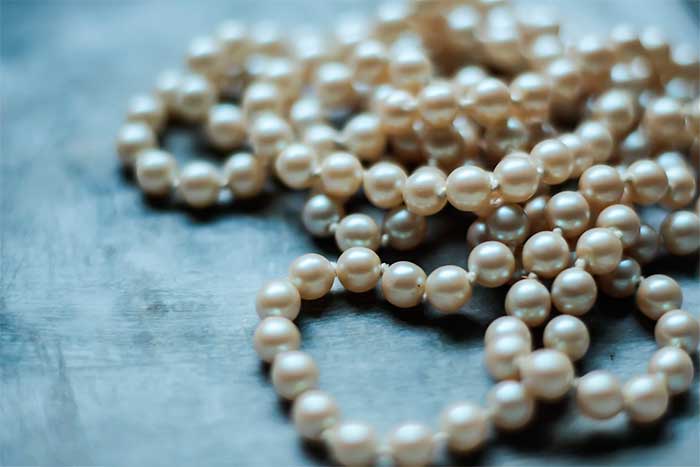
Pearl
for Jewelry
- Along with Coral, this extremely
popular gemstone used in jewelry,
is found in the seas not the land
and is therefore not of the same
composition nor characteristics of
the earth born gemstones. Care must
be taken to preserve the quality of
pearls. Pearls are made of calcium
carbonate formed within an oyster.
The basic irritant is usually a
grain of sand which stimulates the
oyster to cover it with its own body
secretion - eventually forming the
well known round and perfect pearl.
The lustre of the pearl comes from
minute crackles on its surface -
finer than those on opals. Their
lustre increases in the body warmth
of human beings and therefore the
practice of allowing the shop
attendants to wear the strings of
pearl has a practical basis.
Different pearl qualities depend
upon colour and size and range from
the tiniest "seed pearls" to the
rare gems of considerable size
Harvesting pearls from the wild is
singularly unrewarding and cultured
pearls have been able to meet the
demand for these beautiful natural
ornaments. Cultured pearls have been
produced in China for several
centuries as now in Japan, Australia
and the Pacific.
Ruby
for Jewelry - Next to diamond,
ruby (and
sapphire) are the most valued of
the gems. Ruby is a variety of
corundum, When the corundum includes
chromium, it becomes ruby, when it
contains titanium and iron instead
and therefore is blue - the
sapphire. The world's finest come
from Myanmar, Pakistan and
Afghanistan, also Burma, Thailand,
India and Ceylon .Burmese ones are
exceptionally beautiful - found near Mogo N.E. of Mandalay. "Pigeon
Blood" rubies are the highest in the
scale of value. Thai Rubies are
often found with spinel and are
darker red than the Burmese Rubies.
A fine ruby is a magnificent
gemstone. Ruby has been
synthetically produced successfully
since 1904. But the genuine rubies
are valued because of their rarity
and therefore have not dropped in
commercial value, in fact have
risen. Rubies are also used in Space
research in connection with
communication systems to cut out
surface sounds of the earth and pick
up beams from space.
Sapphire for Jewelry
- Pink Sapphires, Blue sapphires and
Yellow Sapphires are found in
Thailand and East Africa. They are
next to diamond in hardness and
therefore resistant to wear.
Australia is the largest producer of
blue and golden sapphires. Non-blue
sapphires are White Sapphires or
Golden Sapphires. The largest
sapphire known was 950 carats from
Burma. The largest in Australia was
886 carats from Queensland in 1934.
There are star sapphires and star
rubies found which contain fine
fibre crystals giving star effect
when cut in en cabochon.
Topaz
for Jewelry
- Topaz is an aluminium silicate
containing about 20% water and
fluorine and comes in several
colours. Yellow quartz is sold today
under the name of topaz and it is
one of the most popular colours,
although there are others which are
greenish and of reddish tint..
Golden Topaz from Brazil is a golden
brown to pink colour. The main
suppliers are Brazil, Germany and
Russia. Japan also produces topaz.
Topaz is harder than Rock crystal
and is known for its huge crystals -
a colourless one from Brazil was
found weighing as much as 600
pounds, well formed and clear
throughout. The largest known topaz
was cut in 1977 and weighed 21,327
carats. Another is known at 36,853
carats. Found in Australia topaz is
usually light yellow, green and blue
also. Hardness 8 and Orthorhombic
crystals brilliant and beautiful
stone found in quartz rose rocks.
Associated with tin ores . Tinted by
heating. Sky blue topaz found in the
Scottish Highlands, Brazil and
Siberia.
Turquoise for Jewelry - This stone is
composed of aluminium copper
sulphate hydrated phosphate of
aluminium and copper) and is only
medium hard. Egyptians are the first
people known to mine it in Sinai
over 6000 years ago. The finest is
said to be found in Naishapur,
Iran, where it has been
mined for about 3000 years.
It is found also in Sinar, Turkestan and
Tibet. The colours range from pale
blue to deep green/blue. Water
content affects the colour of the
stone. It responds to human touch
and warmth and in the Middle East is
used as a reflector of babies'
health in the crib etc. It is
relatively soft and has a waxy lustre. It is porous and its colour
may deteriorate if skin oils and
cosmetics are absorbed during wear.
It's famous for its change of colour
when difficult influences are near
and for this reason was attached to
cradle of babies to reflect the
child's vitality and to alert them
to any change in tone and colour.
Some believe it becomes moist and
changes colour when warning against
Poison. The gem is regarded as a
pledge of true affection and drawing
evil influences. The green variety
is found in New Mexico and in
Australia.
Author Michael
Russell, your
Independent guide to
Jewellery.
What's new in minerals for Jewelry ?
The Rochester Mineralogical
Symposium was held for the 21st
year. This event has grown in
stature through the years and is
regarded as one of the best
mineralogical symposia in the
country. Although there are dealers,
it is still, first and foremost, a
symposium. All dealers must close
their doors during the lectures and
scheduled activities. Plenty of time
is allowed for shopping breaks, and
collectors can use their silver
picks in the evenings when dealers
doors stay open late.
There is a refreshing emphasis on
minerals for jewelry of the northeast and
north-central United States. It is
always good to see material from old
localities where I used to collect
while growing up in Connecticut.
Northeast dealers were not the only
ones there though. Cal Graeber
Minerals (P.O. Box 2347, Fallbrook,
CA 92088) had some of the superb
peridot crystals that have been
coming out of Pyaung Gaung, Myanmar
(= Burma) recently. The crystal
faces are rough, as though etched,
but the interiors are extremely
gemmy and of a fine green color.
Some of these were available at the
Tucson Show.
The Bennett mine in Buckfield, Maine
produced some fine specimens
last season. These included mil
quartz crystals, cassiterite,
columbite, hydroxylherderite,
pollucite and cookeite. The most
exciting crystals were the
multicolored elbaites in shades of
green and pink. Both Jim Mann (Box
597, Bethel, ME 04217) and Cal
Graeber had some of these elbaites.
Heliotrop - photo by pustule
Leonard Himes of Minerals America
had a pleasant surprise---a fine
group of emerald crystals for
jewelry from North
Carolina having several small rutiles attached and included. The
whole specimen stands 4.8 cm high.
Leonard also had several specimens
from the Zomba-Malosa Complex,
Chilwa Alkaline Province, Malawi
(see the article in the
January-February issue). The best
known mineral for jewelry from this locality is aegerine, which Leonard had in
crystals up to 16 cm long, plus
several zircon crystals, sometimes
attached to the aegerines.
Pakistan continues to produce
interesting new minerals for jewelry, or just
better ones than from other
localities. Dudley Blauwet of
Mountain Minerals International
keeps on top of these things. He had
some rather nice zircon from Buibin,
near Astar, Waziret district,
Northern Areas. They are clean,
reddish brown dipyramids in what
appeared to be a very impure marble,
in crystals up to 1.5 cm. Some of
these have been available recently,
but as loose crystals with no
matrix.
Dassu, Baltistan, Northern Areas was
represented by stellerite in white
hemispheres to 2.5 cm in diameter.
Most are loose groups, some with
minor muscovite matrix. They are not
as lustrous as the stellerites from
Jalgaon, India, but quite
interesting considering the
pegmatite origin. Dudley also had
some of the steilerites from Jalgaon,
which have a beautiful luster and
translucency, some with chalcedony
and gyrolite on gray-blue drusy
quartz.
A fairly new dealer in the business
is DeTrin-Rising Sun (145-62 7th
Ave., Whitestone, NY 11357) who
specializes in the minerals for
jewelry of
Russia and its former republics. I
think that some of us are reaching a
degree of saturation with minerals
from those areas, because there has
been so much available recently.
Unfortunately, much of the material
available these days is mediocre
and/or damaged. Not so with the
material of DeTrin, the owner of
which seem to have a great eye for
the best quality material. Most of
their stock was the typical suite
from Dalnegorsk, but of very fine
quality. I look forward to what this
dealer will bring forth in the
future.
Jeffrey B. Fast (19 Oak Knoll Rd.,
E. Hampton, CT 06424) made available
a fine selection of the new material
for jewelry from the Becker quarry, West
Willington, Connecticut. The suite
includes pale smoky, tessin-habit
quartz to 7 cm long, pocket
almandine crystals to 2.5 cm and
white magnesite rhombs to 1 cm with
minor drusy pyrite. One of the
minerals I wanted to see was not in
the room--the terminated pocket
kyanite.
Some other local material for
jewelry was being
handled by Lawrence D. Venezia (115
Coleridge St., E. Boston, MA 02128).
Rare, but not particularly
attractive, were masses of orange
donpeacorite from Balmat, New York.
From Pearl Lake, Lisbon, New
Hampshire, Larry had some very clean
almandine and staurolite in schist.
The staurolites are up to 5 cm in
length and many have small garnets
sprinkled on them.
Topaz-Mineral Exploration's
specialty (1605 Hillcrest, Grand
Haven, MI 49417) is the minerals of
Michigan's Upper Peninsula. Tom Bee,
the owner, besides having an
eye-opening display of minerals from
that area, had many for sale. He had
one of the finest assemblages of
well-crystallized copper that I have
seen in a while, plus fine calcite
with copper inclusions, half-breeds,
datolite and epidote on calcite.
Many of these specimens have come
out of old collections. There was a
buying frenzy in his room; I almost
had to fight someone to photograph a
piece before it was bought. Luckily
the fellow and I are still friends.
That fellow is Gary Richards, Keeper
of the Earth (2511 N. Mason,
Appleton, WI 54914). Gary is a very
experienced dealer who spent a
number of years helping Lance Hampel.
On his own now, Gary is doing a fine
job and also has a special fondness
for minerals of the U.P. (Upper
Peninsula), as they call it in those
parts. Gary had recently bought an
old collection that was heavy in
pegmatite minerals, especially
tourmaline and beryl. Localities
included some of the common and
expected--Afghanistan, Pakistan,
Nigeria, California, Brazil--plus
some that are not so common. These
included Rabenstein, Bavaria;
Namibia; Adun Chulon and Mursinka
(both in Russia) and the old
Gillette quarry, Haddam Neck,
Connecticut. I was pleased to
relieve Gary of the beryl from that
last locality as well as the one
from Mursinka.
Hans van Binsbergen of Classic
Minerals (P.O. Box 1391, Exton, PA
19341) had been holding on to a
batch of very high quality Lynch
Station, Virginia turquoise for
jewelry that had
been collected about five years ago.
He offered for sale eight flats of
bright blue, microcrystalline druses
on quartz.
The new red grossularite seen at the
Tucson Show was well represented in
the room of Beau Gordon (Jendon
Minerals, P.O. Box 6214, Rome, GA
30162). They are from Sierra de La
Cruz, Coahuila, Mexico and ranged
from thumbnail to small cabinet
size, all on matrix. Beau also had a
nice selection of crudely
crystallized gold from Mt. Kare,
Papua, New Guinea. Most are slightly
waterworn, small nuggets.
Mongort Minerals was a new name to
me, and a pleasant surprise. Raymond
Sprague and his partners have opened
up the old Emmons quarry, Uncle Tom Mtn., Greenwood, Maine. They have
leased the property since 1990 and
have produced some interesting
material. Included are blue/gray to
pale purple nuorapatite on albite in
thumbnail sizes; and milky white and
zoned, multiple and parallel grown
quartz crystals, sometimes sceptered,
to 13 cm. They hit one pocket 4
meters across, mostly filled with
mustovite in six-sided crystals with
fibrous overgrowths, associated with
bertrandite microcrystals. The
quarry is also producing some nice
green to pink elbaite crystals up to
10 cm long. Unfortunately, most of
the elbaites are broken and
repaired. Ray hopes that as they get
deeper below the frost line, the
elbaites will be in better shape.
Mongort also had minerals from other
localities in Maine, such as
fluorapatite from the Harvard quarry
in Greenwood, and microcrystals and
thumbnails of perhamite from the Ski
Pike quarry, Cobble Hill, West
Paris.
There were a number of Canadian
dealers including Collection
Haineault (2266 St-Alexandre,
Longueuil, Quebec J4J 3T9) who had
some very good material for jewelry from Mont
Saint-Hilaire, Quebec. Besides the
fine serandite and leifite, Gilles
Haineault offered a fine group of
carltonite crystals as singles to 1
cm and large groups to 14 cm across.
The crystals arc of the typical
blocky habit, with blue cores and
white exteriors. From the Jeffrey
quarry, Asbestos, Quebec there were
some very nice, zoned, green to
purple vesuvianites.
Jim Mann is a fellow who gets
around; he bought some of the better
elbaites from last summer's
production at Mount Mica, Paris,
Maine. As I mentioned earlier in the
column, he also had some of the
better material from the Bennett
mine, Buckfield, Maine, the most
notable being the elbaites. Also
very interesting from the Bennett
mine, was a rhodochrosite crystal 2
cm tall that some were claiming to
be the best such crystal to come
from a granite pegmatite (see
photo). Although not as deep a
purple as the fluorapatites of Mt.
Apatite, those of Mt. Rubellite are
quite fine. Jim showed me one, 1.3
cm across on a matrix of quartz
prisms, that I would have been quite
proud to own.
It seems that the specimens lately
just keep getting better from the
Bunker Hill mine, Kellogg, Idaho.
John Cesar had for sale some cerussite from the recent efforts at
that mine. The lustrous white
crystals are nicely twinned, in
groups up to 11.5 cm, that could
almost be mistaken for Tsumeb.
The weather was typically cold and
rainy, but since few of us left the
confines of the hotel for the
duration of the Symposium, it hardly
mattered. There was of course, a
fascinating group of speakers with
topics that ranged from technical to
entertaining to disturbing. The
exhibits were inspiring and I vowed
to get out and do more field
collecting. The Symposium is not a
big one for dealers or for new
things, but it is an intense,
enjoyable experience, all the more
so because attendees are all serious
collectors and students of
mineralogy.
Author Scovil,
Jeffrey ACopyright Mineralogical Record
Provided by ProQuest Information and
Learning Company. All rights
Reserved
Gem
minerals in early Arabic literature
Gem formation, composition,
properties, sources, occurrences,
enhancement techniques, color
grading and commercial values-all
were topics of interest to the early
Arabs. By "early" is meant the 9th
to the 14th centuries A.D., when
this literature flourished by way of
treatises, cosmographies and travelogs.
The men who penned these documents
were of different backgrounds,
ranging from scientists to
international globe-trotters. A few
were supported financially by
aristocratic patrons.(1) The thing
they all had in common was a
curiosity about gem minerals.
Arabic writings on gems for jewelry number in
the many hundreds of pages. This
article gives a brief literary
survey of those writings. The scope
of this survey is limited to what
the Arabs had to say about several
of the more important gems: ruby,
sapphire, emerald, red spinel,
peridot, lapis lazuli and pearl.
Physical properties, enhancement
techniques and imitations are
discussed, insofar as they concern
some of these same gem materials.
Whenever possible, Arabic-language
documents were consulted in
preparing this paper. Unless
otherwise stated, Arabic
translations are those of the author
and are being published here for the
first time. Where comments of my own
are inserted they are set off in
square brackets.
So, get ready for a trip back in
time and a tour of lost mines for
jewelry. The
players in this venue are several
men, long since dead, whose
manuscripts are perennial in the
spirit they convey. Perhaps you will
find that, though the centuries may
pass, life is in many ways still the
same as it was then.
What the Arabs Say about Corundum
A well-known treatise written around
1240 A.D. by a man named Teifaschi
describes a wide range of gem
materials. Like other Arabs who
wrote about gems, Teifaschi places
much emphasis on yaqut, a term that
at times embraced several gem
species but seemed most often to
signify corundum. He delineates its
color varieties, discusses sources,
and notes that "it is heavier than
all other stones of the same size.'
Speaking of deposits in what is now
Sri Lanka, our author observes:
Yaqut is brought from a mine named
Sahiran which is on an island about
forty parasangs beyond Sarandib [Sri
Lanka]. The island itself is about
sixty parasangs across. There is a
large mountain on this island named
Mount Rahun. Winds and torrents
cause the yaqut to descend, after
which it is collected [at the foot
of the mountain]...
The text appears to have been
garbled in its rendition, for there
is no island near Sri Lanka that
meets this description. In fact,
this passage refers to gem material
found in the area about Adam's Peak
in Sri Lanka's Ratnapura district.
Adam's Peak (Rahun was often
mentioned in these accounts, and not
only for its minerals; it was
revered among Muslims as a place of
pilgrimage, for Adam himself was
thought to have landed there when
cast out from Paradise. Bearing in
mind that Muslims have dominated Sri
Lanka's gem trade since at least the
10th century, one can appreciate
that these pilgrimages often doubled
as business trips!
The heat treatment of corundum is
also described in Tifaschi's
treatise. He notes that heating is
used to improve the color of ruby.
In a fascinating excerpt, he relates
how this enhancement technique was
employed in Sri Lanka [= Sarandib, =
Ceylon]:
In Sarandib and its environs, ruby
is treated by fire. People take
pebbles from the earth and crush and
compress them into a mass with the
aid of water. [This mixture] is
daubed completely around a dry
stone. Then, the whole thing is
placed on a rock with other rocks
set down around it. Dry firewood is
thrown on top, lit and blown upon
[with bellows]. The blowing is
applied, along with more wood, till
any black overtones on the ruby have
disappeared.
The amount of fire and the
application of wood depends on the
extent of the blackness present.
People know this by experience. They
heat treat stones for at least one
hour and, at most, twenty days and
nights. Then, they carefully extract
the ruby, its blackness having
disappeared.
The ruby is not heat treated a
second time. After one treatment,
its color can neither improve nor
diminish...
This passage may surprise those who
think that heat treatment is a Thai
innovation of the past few decades.
Interestingly, the method Tifaschi
describes is reminiscent of
so-called primitive heat treatment
procedures used today in Thailand.
It is, moreover, safe to assume that
similar techniques were employed for
centuries on the Island of Gems; Sir
James Tennent, the author of the
Victorian classic, Ceyn, records
that the Singhalese remove the blue
tinge of ruby "by enveloping the
stone in the lime of a calcined
shell and exposing it to a high
heat." Teifaschi was not the first
Arabic writer to discuss heat
treatment. Two hundred years earlier
a scientist named al-Biruni spoke of
it in a probable reference to red
spinel.
Specific Gravity; Ruby vs. Red
Spinel
Abu Rayhan Muhammad Ibn Ahmad
A1-Biruni (973-1050) was one of the
most brilliant men of his age.
During the 11th century he authored
over 120 works on an incredible
number of subjects, including a text
of several hundred pages devoted
exclusively to gem minerals. His
superbly objective mind sets him
apart from contemporaries in that he
always questioned, always tried to
corroborate things by way of
experimentation and empirical
confirmation. In effect he was one
of the earliest practitioners of the
Scientific Method.
Al-Biruni's most valuable
contributions to what are now called
the sciences of gemology and
mineralogy are his specific gravity
experiments. The specific gravity
values he derived are known to
modern-day scholars of medieval
Arabic literature, but have not
attained much press elsewhere. For
example, he gives the specific
gravity of red spinel as 3.58, blue
sapphire as 3.97 and ruby as 3.85.
These measurements do not deviate
appreciably from the currently
accepted values of 3.581 for spinel
and 3.987 to 4.1 for corundum.
Besides spinel and corundum, al-Biruni
tabulates the specific gravities of
other gem materials.
It is interesting that at least some
of the Arabs appear to have
distinguished red spinel from ruby,
which was not the case in Europe
till the nineteenth century. Even
with respect to nomenclature, red spinel is balkhash, while corundum
is almost invariably called yaqut.
The Gems of Afghanistan;
Fluorescence
Although early Arabs indicate Sri
Lanka as the main corundum source,
the Badakhshan region of Afghanistan
is frequently mentioned for its red
spinel, garnet and lapis lazuli.
References to Badakhshan appear in
the writings of al-Muqaddasi (10th
century), al-Biruni, Teifaschi and
other chroniclers. One such
chronicler was an encyclopedist
named, coincidentally, Yaqut
(corundum!).
Shihab al-Din Abu Abdallah Yaqut Ibn
Abd Allah Yaqut al-Hamawi al-Rumi
(1179-1229) was most famous for his
geographical encyclopedia. This
magnum opus alphabetically lists
cities and towns in the then-known
world, defining location, commercial
products, resources, weather
conditions and so forth.(2) It is
hundreds of pages long. Badakhshan
is one of many places cited for gem
deposits. Here Yaqut notes that the
mountains of Badakhshan are renown
for lapis lazuli and balkhash,
though he adds that the latter tends
to be of low quality. He goes on to
say that Badakhshan produces a
curious stone that glows in the
dark, perhaps alluding to the strong
fluorescence of some rubies and red
spinels.
It is important to remember at this
point that some of these writers-and Yaqut was no exception--felt free to
recount stories and "facts" that had
been passed on from earlier sources,
as distorted or exaggerated as they
might be. The idea of stones glowing
in the dark is mentioned frequently.
Fluorescence may well have been the
inspiration behind this kind of
story.
One passage in Tifaschi's book
leaves little doubt that
fluorescence was observed and even
appreciated as a beauty factor by
contemporaries of the day. The
author distinguishes seven
color-appearance types for ruby,
singling out one in particular,
which he calls alavjuani. Teifaschi
defines this appearance by analogy
with "a burning coal."
Emerald vs. Peridot; The Question
of Lost Mines
Much was written about emerald
during these centuries, though it
seems at times to have been confused
with peridot. Perhaps this confusion
is echoed by al-Biruni when he says
that zumurrwud--the usual Arabic
word for emerald--is synonymous with
zabarjad. Note that Zabarjad is the
name the Arabs use even today for a
certain island in the Red Sea; on
English maps it goes by the name of
St. John's, a famous but now largely
exhausted source for peridot, not
emerald (Wilson, 1976).
Elsewhere in his ten-page section on
emerald, al-Biruni limits sources to
"Egypt, the oases, Mount Muqattam
and the Land of the Bujja." Mount
Muqattam refers to a range of hills
east of Cairo, and Bujja was the
name of a tribe residing to the
south. Al-Biruni goes on to list
emerald mine locations cited by
earlier writers. In a probable
reference to the so-called
Cleopatra's Mines of Sikkit and
Zubara, he quotes one author as
saying:
Verily, the emerald source is in
Upper Egypt, along the southern
Nile, in an open plain that is cut
off from civilization. No other mine
on earth is known to have emerald.
Still later, al-Biruni cites a
chronicler to the effect that
"Emerald is borne by water and mixed
with sand. It is extracted from
wells, along with the sand."
Finally, he relates a mining
technique recorded by the Razi
Brothers, who say that
emerald-bearing matrix is daubed
with oil, making the emerald easier
to spot.
Possibly the most interesting part
of al-Biruni's section on emerald is
the reference to mines at the oases
and Mount Muqattam. Which oases is
he speaking of? And were the Muqattam hills an actual source for
emerald, assuming he is not
confusing emerald (zummurud) with
some other green stone? Was Muqattam
a source for emerald in times of
yore? The prospect is fascinating,
as historians generally regard the
area of Sikkit and Zubara as the
only two sources in Egypt that
yielded this material (see, for
example, Bauer, 1970; Bancroft,
1984; Sinkankas, 1981. The Muqattam
hills are hundreds of miles to the
north, in Lower Egypt!(3)
Besides sources and mining tips, al-Biruni
discusses the color-grading of
emeralds, imitations encountered in
the marketplace, and prices. The
pricing information is on a table
which relates value, in silver
dirhams, to carat weight. For
example, a 9-carat emerald is listed
at 8,000 dirhams.
The Fuller Historical Perspective
The above citations barely scratch
the surface in relation to what the
Arabs wrote on rocks, minerals and mineraloids. As such, this article
can only afford the reader a glimpse
at the subject. Fleeting as this
glimpse might be, however, it is
important to view this material in
its fuller historical perspective.
Mineralogy, gemology, petrology and
metallurgy were not distinct
disciplines during the Middle Ages.
All were lumped together under the
broader umbrella of natural science,
with metallurgy seen by some as
little more than a form of alchemy.
Books treating of rocks, minerals
and amorphous materials often
included chapters on metals, advice
on local gem trade practices, and
bits of older poetry. One genre of
Arabic literature, the
cosmographies, typically contained
the above information along with
popular superstitions on the
medicinal properties of stones, gems
as amulets, exaggerated accounts
about magnetic properties, etc. (Sersen,
1987).
These authors sometimes plagiarized
earlier writings, but this was by no
means the rule. Men like al-Biruni
and Tifaschi frequently credited
their sources, among them Greeks and
other Arabs. Aristotle, Xenocrates,
Dioscorides and Theophrastus are
among the Greeks who influenced this
genre of Arabic literature. The
Arabs built upon this legacy, adding
many contributions of their own.
One of the earliest Arab sources
cited by Arab writers is al-Kindi. A
scion of the Arabian tribe of Kinda
in Yemen, Abu Yusuf Yaqub Ibn Ishaq
al-Sabbah al-Kindi (ca. 801-ca. 866)
was a polymath of the first order,
not unlike al-Biruni. His literary
output was tremendous, and included
A Treatise on the Kinds of Stones
and A Treatise on the Kinds of
Jewels, Precious Ones and Others. No
copy of either of these works has
survived.
Al-Kindi is quoted on numerous
occasions by al-Biruni and others.
His books on gems are listed in The
Index, an annotated bibliography of
the 10th century compiled by the bookdealer Ibn al-Nadim.(4)
Finally, no survey of this
literature is complete without
mentioning the Stone Book of
Aristotle, sometimes translated as
the Laidary of Aristotle. Appearing
in Arabic in the 9th century, this
text was often cited by later Arab
authors. It is somewhat of an
enigma, as modern scholars are not
sure who wrote it. Title
notwithstanding, it is generally
agreed that Aristotle was not the
author. The Stone Book of Aristotle
bears marks of Greek and Arab
influence. Fortunately, it is
preserved today; a German
orientalist, Julius Ruska, published
the Arabic text along with a German
translation in 1912.
Availability of Source Materials
Little research has been done by
modern scholars into the medieval
Arabic gem-related literature. The
bulk of this material is untranslated; much of it has not
even been edited in Arabic from the
original manuscript sources.
Since the nineteenth century,
several (primarily) French and
German orientalists have translated
select passages and texts.(5)
Unfortunately, these translations
have appeared in specialized
periodicals which only orientalists
and Middle East historians tend to
read. As a result, modern
gemologists, mineralogists and
others are generally unaware of this
fascinating corpus of early Arab
literature.
Most of the secondary-source
publications consulted for this
article and otherwise listed in the
bibliography are available at major
university libraries in the United
States, England and West Germany.
Arabic primary sources or
photocopies thereof are more
difficult to come by; people wishing
to access such materials are best
directed to the British Library
facilities at the British Museum,
London, or the library of the School
of Oriental and African Studies,
London University.
Conclusions
This paper was written in order to
fill a gap. By "gap" I mean the
general lack of awareness of Arab
contributions to the gem and mineral
sciences. It was presented as a
literary survey, with the specific
intention of whetting the reader's
appetite to explore the subject
further.
As we have seen, Arabic writings
often described gems in terms of
sources, occurrences, mining
techniques, physical properties,
treatments and imitations. Though
there can be little question that
Greek literature influenced some of
these writings, it is equally clear
that the Arabs contributed much of
their own: i.e., al-Biruni's
specific gravity experiments,
Teifaschi's narrative on Sri Lankan
heat-treatment of corundum, the
distinction some Arabs made between
red spinel and ruby, and numerous
reports by different writers on gem
sources and occurrences.
This article is by no means an
exhaustive study of the Arabic
"stone books." The literature goes
on to describe other gem species.
For example, the Arabs devoted many
pages to diamond, quartz, turquoise
and malachite. Lapidary methods were
mentioned, with regard to polishing
techniques, equipment and abrasives.
There were more references to
physical properties, gem treatments,
imitations, sources and occurrences.
Gemstone marketing centers,
particularly the one that existed in
Baghdad, were also addressed. A
tremendous amount of material was
written just on the medicinal
properties of stones and the use of
gems in quasi-magical applications,
notably as amulets and talismans.
A bibliography follows which lists
the more important English, German
and French translations and studies
of this literature. Arabic-language
works are included. Though most of
what the Arabs wrote on stones still
remains untranslated, the reader can
explore the subject further by way
of the translations and monographs
cited below.
Acknowledgments
I would like to thank the following
people for their assistance:
Professor Charles F. Beckingham,
formerly of the School of Oriental
and African Studies, London
University, for his many useful
suggestions on accessing Arabic
source materials; Professor Owen
Wright of the School of Oriental and
African Studies, London University,
for granting access to S.O.A.S.
library facilities; the head
librarians of the British Library
Reading Room and the India Office
Library, London, for granting access
to library facilities; and Mr. R.
Scott Montgomery and Mrs. Bridgette
McDonald of the Asian Institute of
Gemological Sciences, Bangkok, for
their comments.
Special thanks are due Mr. Laurence
Lee of London and Miss Phoonsri
Suwanphan of Bangkok. These, my
gracious hosts, managed to put up
with my frequent mutterings in
several languages while I researched
this paper.
1 Patronage of scholarship was not
uncommon in those days; the patrons
themselves saw it as a way to glean
prestige. The amount of prestige so
obtained was perhaps limited,
however, since the masses of people
were generally illiterate!
2 Several geographical encyclopedias
were compiled by the Arabs, though
Yaqut's is the most famous. These
encyclopedias had their roots in an
earlier literary genre, the
so-called "books of roads and
highways," which described towns,
cities and the distances between
them. The books of roads and
highways were of use to postal
authorities and the military, while
the latter-day geographical
encyclopedias probably captured more
of a general audience.
3 Even if the Muqattam hills did
produce emerald in the past, this
does not mean there is any to be
found today, at least in commercial
quantities. The reason some "lost"
mines tend to get lost and forgotten
in the first place, is because they
were mined out! Nevertheless, it
would be interesting to explore the
region for evidence of former mining
activity.
4 The Index (al-fihrist in Arabic)
is invaluable, in that it gives us
an idea of the types of books that
were popular at that time. To call
it an annotated bibliography is
somewhat an understatement, as Ibn
al-Nadim frequently embarks on
lengthy commentaries on these books.
His inventory included manuscripts
on gems, medicine, poetry, grammar,
magic, law, religion, botany,
astrology, astronomy and so forth.
Several scholars have edited this
book in Arabic. In 1970 a complete
English translation appeared in two
volumes (see bibliography: Dodge,
1970).
|
|
5 French
and German orientalists--in
particular the Germans--researched
and published numerous articles on
medieval Arabic natural sciences.
One German scholar who deserves
special mention is Eilhard Wiedemann.
Wiedemann is well-known in Germany,
but not elsewhere. An intrepid
scholar, a linguist and physicist,
he was fascinated by medieval Arabic
literature. Wiedemann's interests
were not limited to Arabic
gem-related materials; he also wrote
articles on medieval Arabic
treatises pertaining to optics, the
oceans' ebb and flow, etc.
Author Sersen,
William John
Thailand's Chantaburi the
trading place in Asia for precious
and semi precious stones. |
AL-BIRUNI,
Abu al-Raihan Muhammad ibn Ahmad (no
date) Kitab al-jamahir fi ma'rift
al-jawahir: Cairo, 38, 41.
AL-DIMISHQI, Abu al-Fadl Ja'far ibn
Ali (no date) Alishara mahasin al-tijara.
Edited by Fahami Sa'ad, 41-51.
AL-QAZWINI, Zakarayya ibn Muhammad
ibn Mahmud (1981 Aja'ib al-markhluqat
wa ghava'ib al-mawjuct. Edited by
Farouk Saad. Dar al-Afaq al-Jadida,
Beirut, 242-281.
Advertisement
BANCROFT, P. (1984) Gem Crystal
Tresures. Western Enterprises,
Fallbrook, and Mineralogical Record,
Tucson, 294-297.
BAUER, M. (1970) Pvecious Stones.
Tuttle, Tokyo, 310-311, 500.
CLEMENT-MULLETT, J. J. (1868) Essai
sur la mineralogie arabe. Journal
Asiatique, 6, 40-41; see also 11,
109-253, 502-522.
CONTENT, D. J., ed. (1987) Islamic
Rings and Gems. Philip Wilson
Publishers Ltd., London.
DODGE, B., ed. and translator (1970)
The Fihvist of al-Nadim. Columbia
University Press, 2, 625.
IBN AL-AKNANI (1908) Kitab nukhab
al'dhaka'ir fi ahwal al-jawahir.
Edited by L. Cheikho. Al-Mashriq,
Beirut, 751-765.
IBN AL-NADIM (no date) Kitab al-fihrist.
Dar al-Ma'rifa, Beirut, 364.
KAHLE, P. (1936) Bergkristall, Glas
und Glasflsse nach dem Steinbuch von
el-Beruni. ZeitschrtF der deutschen
morgenlanddischen Gesellschafi,
Leipzig, 322-356.
KHANIKOFF, N. (1860) Analysis and
extracts of the Book of the Balance
of Wisdom, an Arabic work on the
water-balance written by al-Khzini
in the twelfth century. Journal of
the Amevican Oriental Society, 6,
1-128.
KRENICOW, E (1941) The chapter on
pearls in the book on precious
stones by al-Beruni. Isamic Cultuve,
15, 399-421; 16, 21-26.
LE STRANGE, G. (1966) The Lands of
the Eastem CaZzhate. Frank Cass
Company, Ltd., London, 436-437.
MAURER, J. F. (1981) Concise
Dictionary of ScientIfic Biography.
Charles Scribner's Sons, New York,
773 p.
MIELI, A. (1938) La science arabe et
son role dans l'evolution
scientifique mondiale. Leiden,
100-101.
NASR, SEWID HOSSEIN (1975) An
Annotated Bibliograhy of Islamic
Science. Tehran, Iran, lxiv + 432 p.
[In English]
ROSENTHAL, F. (1975) The Classical
Heritage in Islam. Routledge Kegan
Paul, 162.
ROSS, H. D. (1981) The Art of
Bedouin Jewelry: A Saudi Arabian
Pvofile. Arabesque Commercial SA,
Fribourg.
RUSKA, J. (1912) Das Steinbuch des
Aristoteles. Carl Winters
Universitatsbuchhandlung,
Heidelberg.
SCHACHT, J., and BOSWORTH, C. E.
(1974) The Legacy of Islam. Second
edition, Clarendon Press, Oxford,
451, 453.
SERSEN, W. J. (1987) References to
rocks and stones in medieval Arabic
literature. Gemological Digest, 1
C2.
SINKANKAS, J. (1981) Emerald and
Othev Beryls. Chilton Book Company,
Radnor, Pennsylvania, 49, 542-549.
|
|
| |